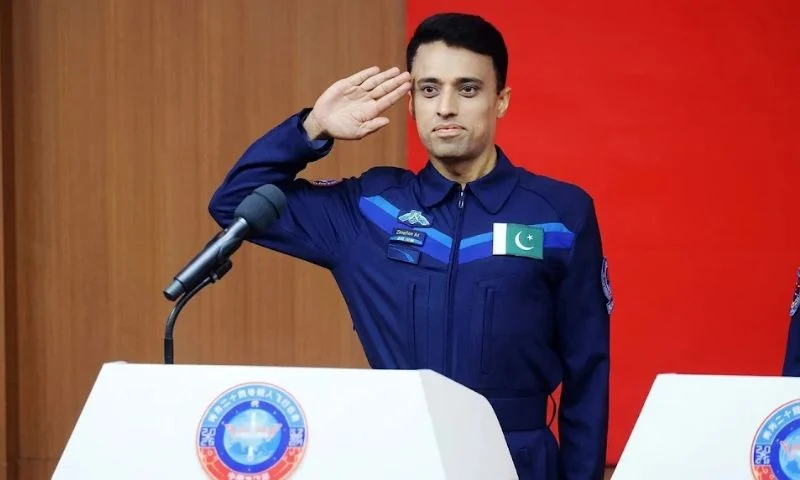
Pakistan has taken a significant step towards greater participation in international space exploration as Wing Commander Muhammad Zeeshan Ali became the first Pakistani astronaut to reach Earth’s orbit, joining China’s Tiangong Space Station on a landmark joint mission.
Ali travelled aboard the Shenzhou-24 spacecraft, launched successfully on November 25, 2026, at 5:18 am Pakistan Standard Time from China’s Jiuquan Satellite Launch Centre. Following a journey of approximately three hours and 38 minutes, the spacecraft docked with the Tiangong Space Station.

His arrival represents a historic development in China’s space programme as well, with Ali becoming the first non-Chinese astronaut to enter the station. He joined Chinese astronauts Tang Hongbo and Wu Yi, serving as a payload specialist during the mission.
The scientific programme offers an opportunity to explore research areas with potential applications in future space technology. Ali is expected to participate in experiments involving biotechnology, microalgae, cyanobacteria, self-healing materials and hybrid composite shielding. Researchers will also explore the possibilities of cultivating quinoa in the space environment.

Such experiments contribute to broader scientific efforts to understand how biological systems and advanced materials can perform beyond Earth, supporting the long-term development of space research and exploration.
Reaching this milestone required extensive preparation. Ali completed specialised astronaut training in China, covering the technical and operational requirements of spaceflight. Learning Chinese was also part of his preparation, highlighting the importance of effective international coordination in a complex scientific mission.
The mission reflects the expanding relationship between Pakistan and China in science, technology and space exploration. It offers a valuable platform for knowledge exchange and could encourage further collaboration in astronaut development, scientific experimentation and advanced research.
Under the mission plan, Ali is expected to spend around five to ten days aboard the orbital station before returning to Earth aboard the Shenzhou-23 spacecraft.

For Pakistan, this mission is an opportunity to strengthen its scientific ambitions and encourage greater interest in space technology among students, researchers and future engineers. It also demonstrates the value of international partnerships in enabling countries to participate in advanced scientific programmes.
Muhammad Zeeshan Ali’s journey is therefore not simply a first for Pakistan. It is a significant step towards a future in which Pakistani scientists and professionals can play a greater role in humanity’s exploration of space.