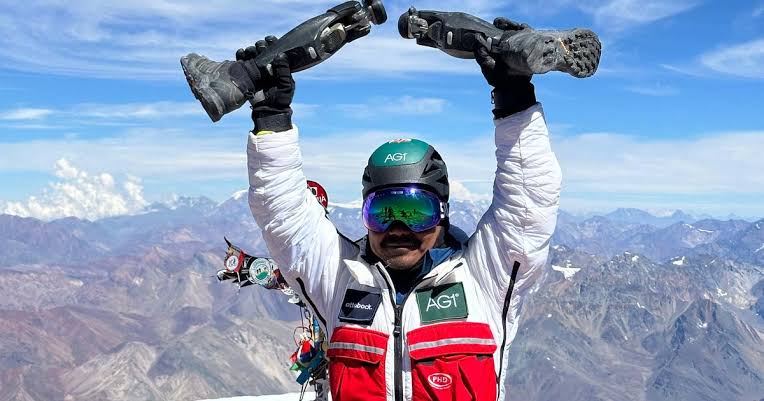
Russian ex-soldier Rustam Nabiev has made global mountaineering history after successfully summiting Mount Everest without prosthetics, relying entirely on his upper body strength and ice axes.
The 34-year-old, who lost both legs in a 2015 barracks collapse, reached the summit on May 20, 2026 at 8:16 am Nepal time. His achievement is being regarded as one of the most extraordinary demonstrations of human endurance and determination in high-altitude climbing, challenging long-held perceptions about physical limits in extreme environments.
Nabiev’s ascent is particularly significant as Everest remains one of the most demanding and dangerous peaks in the world. Completing the climb without prosthetic assistance places his feat in a rare category of adaptive mountaineering achievements. His journey was widely followed online, further amplifying its global impact and inspirational value.
He previously summited Mount Manaslu in 2021, steadily building a reputation for tackling some of the world’s toughest peaks using only his upper body strength. Despite severe conditions during the descent, he successfully returned to Kathmandu and later traveled back to Russia. The summit coincided with his birthday, adding symbolic weight to an already historic moment.
The achievement has sparked widespread attention across social platforms, highlighting themes of resilience, disability inclusion, and human perseverance in extreme sports.