Fine dining is more than food presentation and impeccable service. It is also a language of professional conduct, where table manners, posture, and even the placement of cutlery communicate confidence and refinement.
For hospitality professionals and students, understanding American dining etiquette is an important part of developing the polished service skills expected in international restaurants and hotels.
The American Style and Its Zig-Zag Method
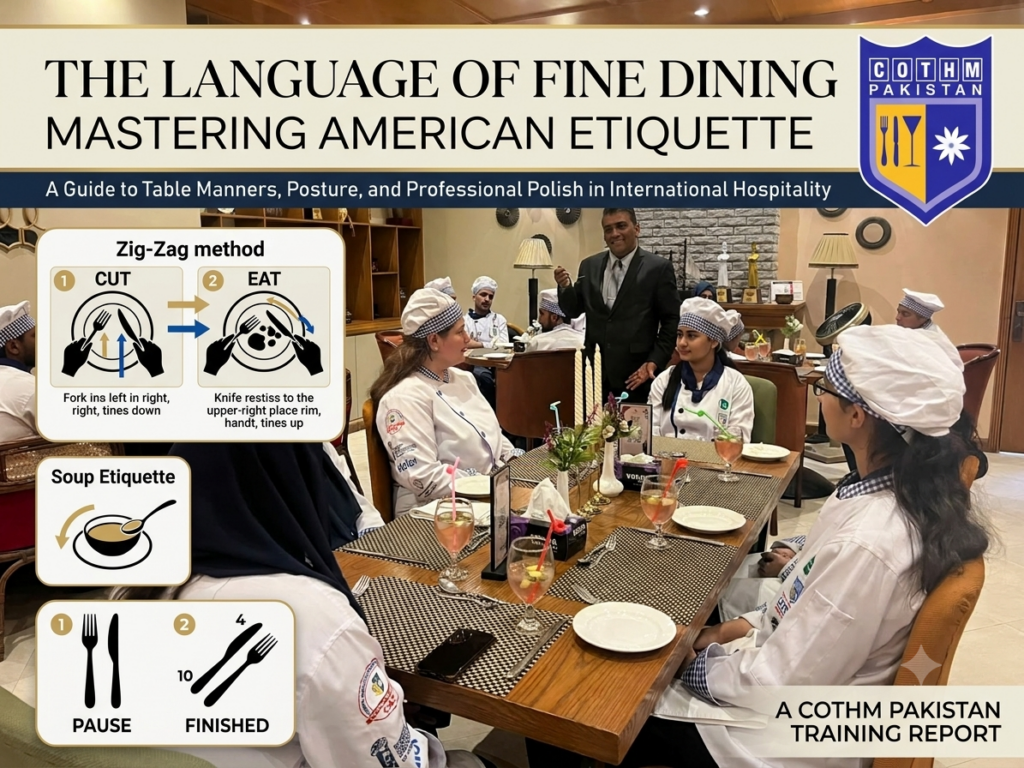
One of the defining features of American dining etiquette is the “zig-zag” method, which differs from the Continental style.
When cutting food, the diner holds the fork in the left hand with the tines facing downward and the knife in the right hand. After cutting a bite-sized portion, the knife is placed on the upper-right section of the plate, with the blade facing inward. The fork is then transferred to the right hand, with the tines facing upward, before the food is eaten.
The repeated movement between cutting and eating gives the American style its distinctive zig-zag character.
The Silent Language of Cutlery
Cutlery can also communicate with servers without words.
When the fork and knife are positioned in an inverted V formation, it generally indicates that the diner is taking a pause and has not yet finished the meal.
When the meal is complete, the fork and knife are placed parallel to each other diagonally across the plate, commonly pointing toward the 4 o’clock to 10 o’clock position. This signals to the server that the diner has finished.
Navigating a Formal Place Setting
A formal American table setting may initially appear complicated, but one simple principle makes it easier: work from the outside in.
Each course is assigned its own utensils. As the meal progresses, diners move inward toward the plate, using the appropriate fork, knife, or spoon for each course.
The Details That Define Fine Dining
Professional etiquette extends beyond cutlery. Guests should unfold their napkin and place it on their lap after being seated. It should not be tucked into the collar.
Elbows should generally remain off the table, while the wrists may rest lightly at the table between courses. Bread should be broken into small pieces by hand rather than cut with a knife.
Soup etiquette also requires attention to technique. The spoon is moved away from the body, and soup is taken from the side of the spoon rather than the tip.
For hospitality students and professionals, mastering these details is not simply about following a set of dining rules. It develops the confidence, awareness, and professional polish required to deliver and understand high-quality international dining experiences.
In fine dining, every gesture matters. The right technique can turn a meal into an experience, and for hospitality professionals, that attention to detail is at the heart of exceptional service.